publications
2026
- Under Review
 Active Sensing for Communication at the Decoding ThresholdJueun Kwon and et al.In Under Review (Preprint available upon request), 2026
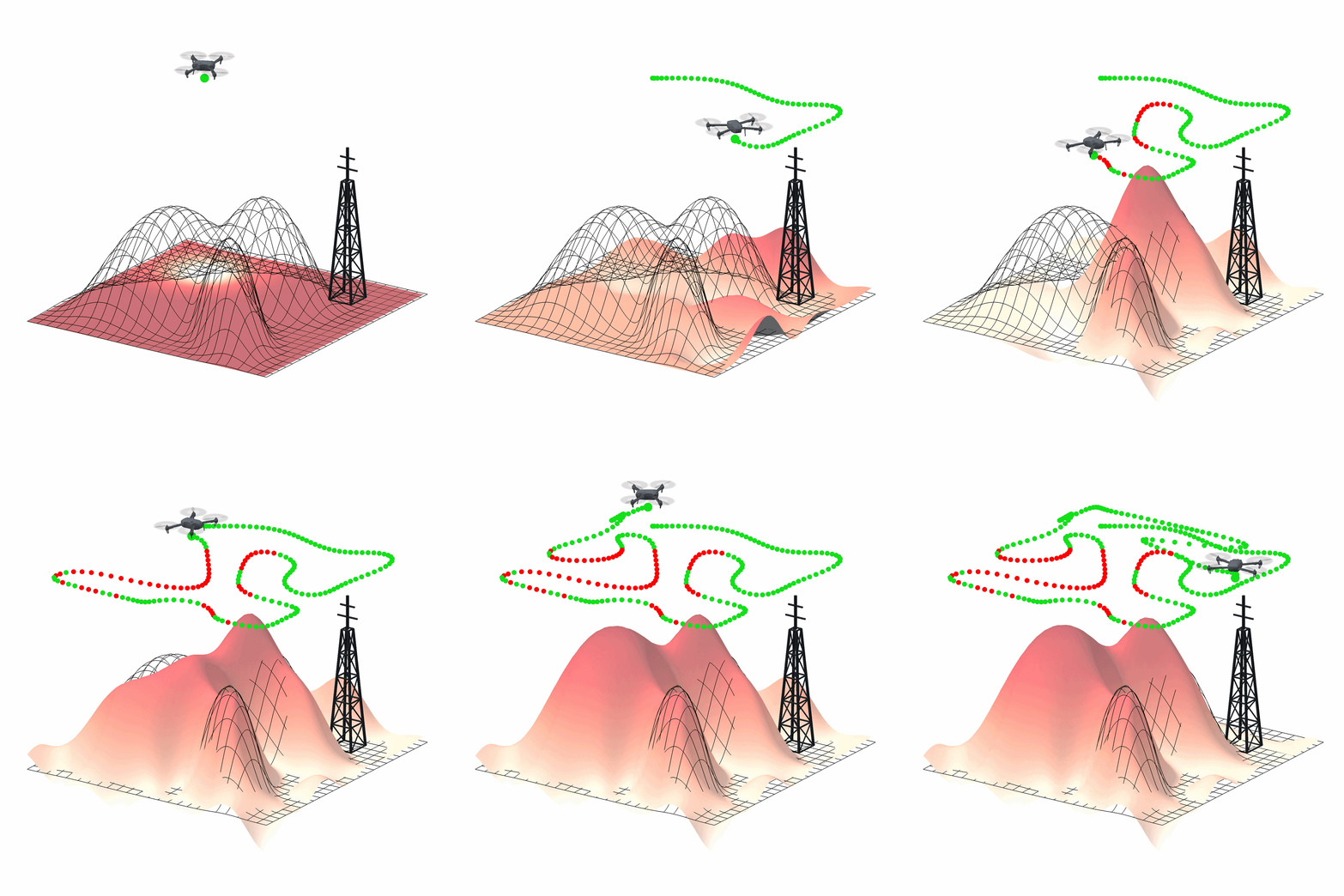
In benign environments, robots using wireless communication assume network connectivity. Whether this assumption holds depends on the communication landscape. In unknown or contested environments, robots will need to estimate the communication landscape themselves. Movement is essential to this estimation process, yet learning the transition between reliable and unreliable communication requires sensing near the decoding threshold, where packet decoding becomes unreliable. In this paper, we formulate active sensing for communication as Gaussian Process (GP) inference, in which packet availability depends on the unknown communication landscape and failed decodes provide binary information about the field. We show that decode-dependent measurement availability can cause greedy next-best-location sensing to repeatedly sample locations where packets fail to decode, degrading communication landscape estimation. We develop a coverage control approach using ergodic control that distributes sensing effort across regions expected to reduce uncertainty, allowing the communication landscape estimate to continue improving when packet failures leave the belief unchanged. We derive a finite-horizon lower bound on the average expected uncertainty reduction associated with the sensing locations visited during a batch and empirically show that ergodic sensing achieves greater posterior uncertainty reduction than greedy sensing under batched updates.
- Under Review
 Value-Preserving Action QuantizationMax M. Sun, Jueun Kwon, Benjamin Riviere, and Todd MurpheyIn Under Review, 2026
Search-based policy learning, such as Monte Carlo tree search (MCTS), offers the flexibility to trade runtime computation for data efficiency and adaptation to novel environments. For robot learning, however, applying search requires discretizing the continuous action space and associated dynamics, typically through action quantization. While reconstruction-based quantization is sufficient for representing the continuous action space alone, policy learning additionally requires the quantized actions to preserve their effects on future states and values. We show that such requirement is not necessarily captured by action reconstruction error. Instead, we prove that the error in the value function resulting from action quantization is tightly bounded by the reconstruction error of state reachability under the quantized actions. Based on these results, we propose value-preserving action quantization (VAQ), which quantizes actions by preserving state reachability. We further combine VAQ with MCTS (VAQ-MCTS) as a value-preserving, search-based policy learning framework for behavioral cloning. Using a wide range of object pushing tasks as a controlled benchmark, we evaluate VAQ-MCTS against state-of-the-art behavioral cloning methods. VAQ-MCTS matches or exceeds their performance under standard settings, while substantially improving data efficiency and robustness to heterogeneous demonstrations, while enabling zero-shot adaptation to novel environments. Hardware experiments further demonstrate the effectiveness of VAQ-MCTS, completing all 30 real-world object pushing trials with only 10 minutes of demonstration data.
- ICRA
 Volumetric Ergodic ControlJueun Kwon, Max M. Sun, and Todd MurpheyIn IEEE International Conference on Robotics and Automation (ICRA), 2026
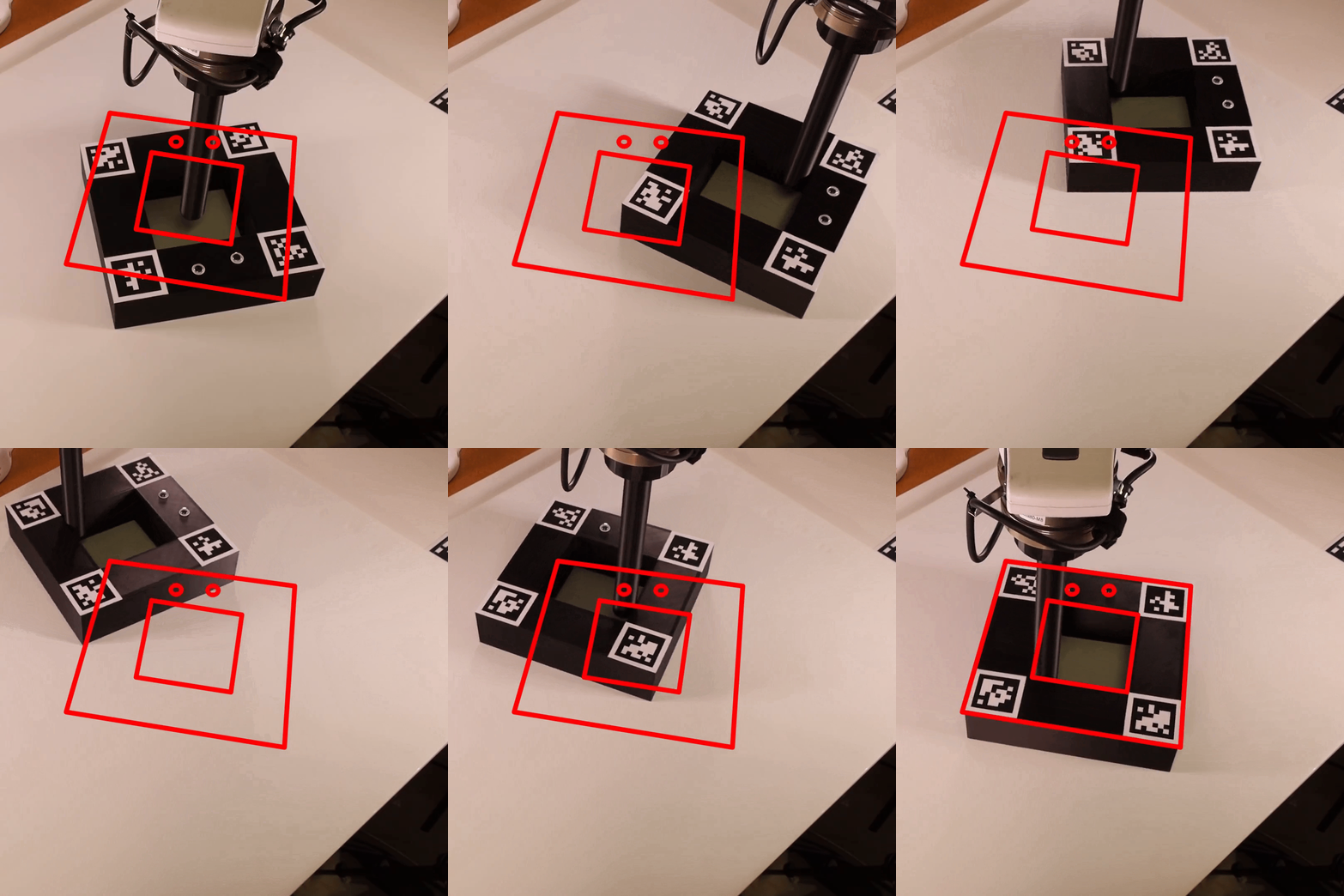
Ergodic control synthesizes optimal coverage behaviors over spatial distributions for nonlinear systems. However, existing formulations model the robot as a non-volumetric point, whereas in practice a robot interacts with the environment through its body and sensors with physical volume. In this work, we introduce a new ergodic control formulation that optimizes spatial coverage using a volumetric state representation. Our method preserves the asymptotic coverage guarantees of ergodic control, adds minimal computational overhead for real-time control, and supports arbitrary sample-based volumetric models. We evaluate our method across search and manipulation tasks – with multiple robot dynamics and end-effector geometries or sensor models – and show that it improves coverage efficiency by more than a factor of two while maintaining a 100% task completion rate across all experiments, outperforming the standard ergodic control method. Finally, we demonstrate the effectiveness of our method on a robot arm performing mechanical erasing tasks.
2025
- CoRL
 CLAMP: Crowdsourcing a LArge-scale in-the-wild haptic dataset with an open-source device for Multimodal robot PerceptionPranav N. Thakkar, Shubhangi Sinha, Karan Baijal, Yuhan (Anjelica) Bian, Leah Lackey, Ben Dodson, Heisen Kong, Jueun Kwon, Amber Li, Yifei Hu, and 3 more authorsIn 9th Annual Conference on Robot Learning, 2025
Robust robot manipulation in unstructured environments often requires understanding object properties that extend beyond geometry, such as material or compliance-properties that can be challenging to infer using vision alone. Multimodal haptic sensing provides a promising avenue for inferring such properties, yet progress has been constrained by the lack of large, diverse, and realistic haptic datasets. In this work, we introduce the CLAMP device, a low-cost (<$200) sensorized reacher-grabber designed to collect large-scale, in-the-wild multimodal haptic data from non-expert users in everyday settings. We deployed 16 CLAMP devices to 41 participants, resulting in the CLAMP dataset, the largest open-source multimodal haptic dataset to date, comprising 12.3 million datapoints across 5357 household objects. Using this dataset, we train a haptic encoder that can infer material and compliance object properties from multimodal haptic data. We leverage this encoder to create the CLAMP model, a visuo-haptic perception model for material recognition that generalizes to novel objects and three robot embodiments with minimal finetuning. We also demonstrate the effectiveness of our model in three real-world robot manipulation tasks: sorting recyclable and non-recyclable waste, retrieving objects from a cluttered bag, and distinguishing overripe from ripe bananas. Our results show that large-scale, in-the-wild haptic data collection can unlock new capabilities for generalizable robot manipulation.
- RSS Workshop
 Scalable Coverage Trajectory Synthesis on GPUs as Statistical InferenceMax M. Sun, Jueun Kwon, and Todd MurpheyIn RSS 2025 Workshop on Parallelized Planning and Control for Robotics, 2025
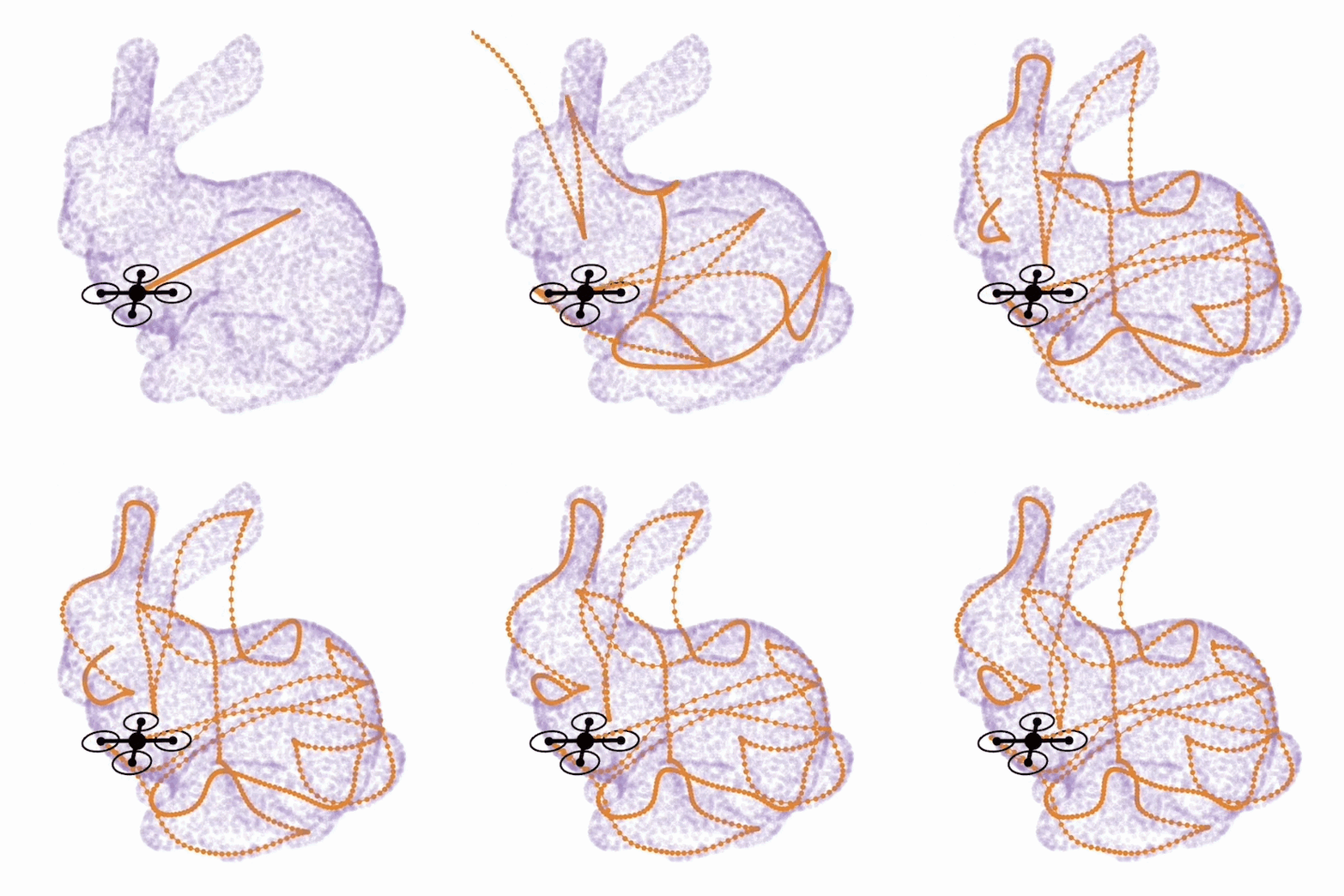
Coverage motion planning is essential to a wide range of robotic tasks. Unlike conventional motion planning problems, which reason over temporal sequences of states, coverage motion planning requires reasoning over the spatial distribution of entire trajectories, making standard motion planning methods limited in computational efficiency and less amenable to modern parallelization frameworks. In this work, we formulate the coverage motion planning problem as a statistical inference problem from the perspective of flow matching, a generative modeling technique that has gained significant attention in recent years. The proposed formulation unifies commonly used statistical discrepancy measures, such as Kullback-Leibler divergence and Sinkhorn divergence, with a standard linear quadratic regulator problem. More importantly, it decouples the generation of trajectory gradients for coverage from the synthesis of control under nonlinear system dynamics, enabling significant acceleration through parallelization on modern computational architectures, particularly Graphics Processing Units (GPUs). This paper focuses on the advantages of this formulation in terms of scalability through parallelization, highlighting its computational benefits compared to conventional methods based on waypoint tracking.